
Checking Calhoun County Criminal History
Begin with the kind of fact you need. A court outcome belongs in a 10th District or 37th Circuit file. Present custody and recent intake data belong to the Calhoun County Correctional Facility. A statewide public Michigan history comes from the Michigan State Police Criminal Justice Information Center. Police narratives stay with the agency that wrote them. Using the right channel first saves time and reduces the risk of joining two people with similar names.
The official Calhoun County government directory is a useful routing point. Gather a full legal name, spelling variants, an approximate year, and a case, incident, or booking number if known. Date of birth helps distinguish a common name where a public system permits that field.
- Search MiCOURT for public district and circuit cases tied to Calhoun County.
- Read the register of actions for charges, events, disposition, sentence, and case status.
- Check Police-to-Citizen when the question concerns present custody or a recent arrest.
- Use ICHAT for the Michigan State Police public statewide criminal-history product.
- Ask the clerk or record-creating agency for an official or certified copy when the online view is not enough.
Three Calhoun Criminal Record Systems
MiCOURT, the jail portal, and ICHAT answer different questions. MiCOURT follows a filed case. The jail system follows a custody event. ICHAT compiles public Michigan criminal-history information reported to the state. A charge may first appear at booking, change when the prosecutor authorizes a complaint, and later end in dismissal, plea, verdict, or another court disposition.
The Michigan Courts Case Search shows how a Calhoun court and search route are chosen.
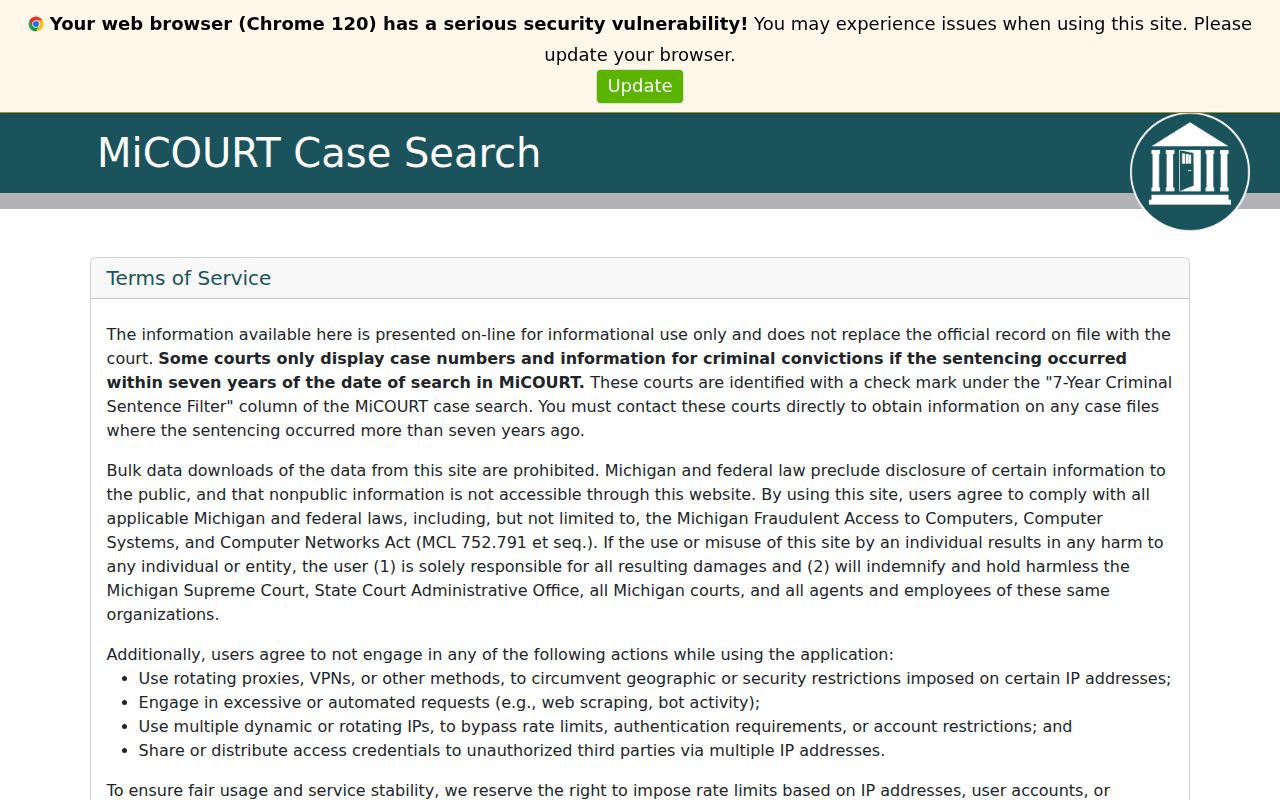
The court selection matters because a felony can produce district-stage events before it is bound over to the 37th Circuit Court. A silent result in one system is not proof that no other public record exists.
| Channel | Best use | Main limit |
|---|---|---|
| MiCOURT | Filed cases and court events | Documents and older files may require the clerk |
| Calhoun P2C | Current inmates and recent arrests | Booking allegations are not dispositions |
| ICHAT | Public statewide Michigan history | Name based and subject to exclusions |
| OTIS | MDOC prison or supervision status | Not a complete county case search |
Michigan Official Background Checks
The Michigan State Police criminal-history service explains the products kept by the Criminal Justice Information Center. ICHAT is a $10 name-based search of the public Michigan product. It does not include suppressed records, federal or out-of-state files, tribal and juvenile records, traffic records, or every non-conviction event. A no-record response means the product found no matching public record. It does not prove that a person has never had contact with a court or police agency.
A person reviewing their own Michigan record can follow MSP instructions for a fingerprint-based personal review. Fingerprints may be taken by a local law-enforcement agency or another accepted fingerprint service and submitted to CJIC. The MSP help desk number published in the research is 517-241-0606. Purpose codes, vendor rules, and fees vary for other fingerprint checks, so current state instructions control.
The MSP criminal-history page is the source for repository access and scope.
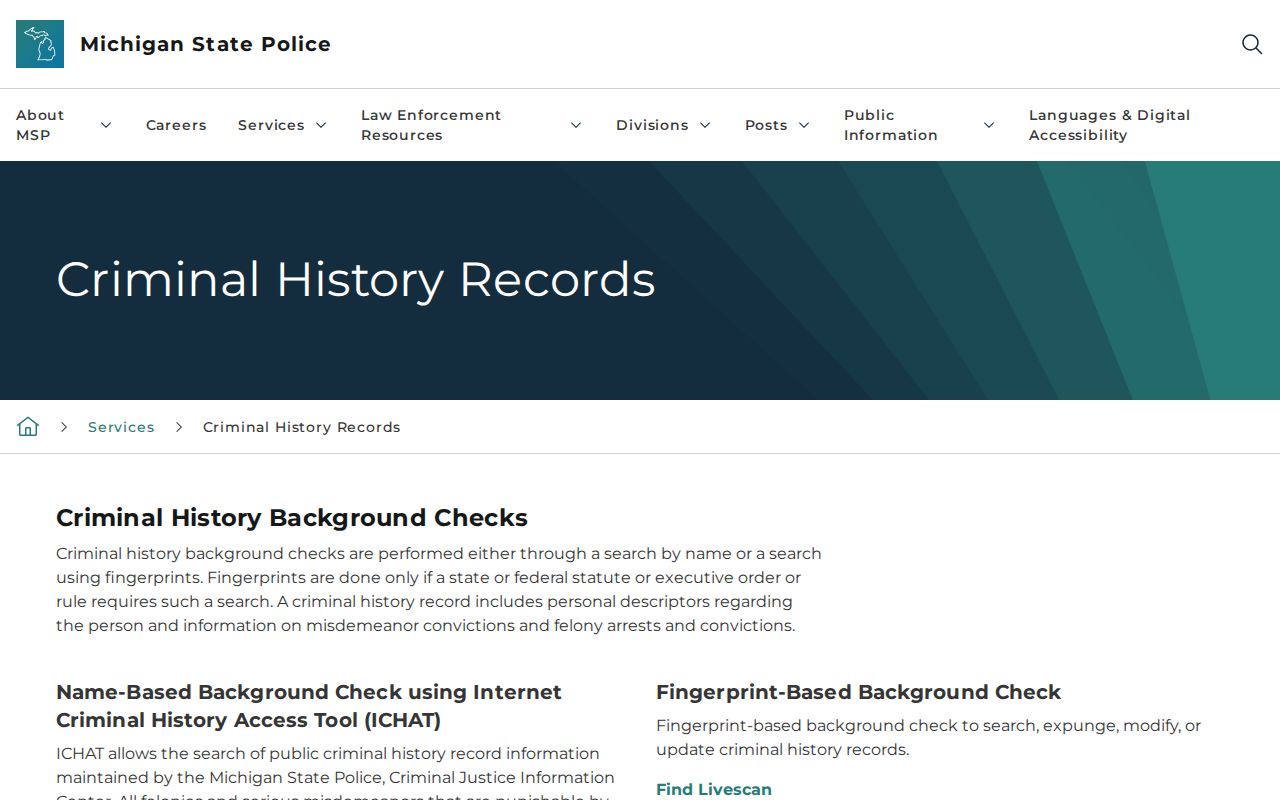
This state layer supplements, but does not replace, the Calhoun court file that proves how a particular charge ended.
Calhoun Records Split Between Cities
Calhoun County has a two-center records geography. Marshall is the county seat and houses the Clerk and Register of Deeds at 315 West Green Street. Yet much criminal-court and custody activity is centered at the Justice Center in Battle Creek. The sheriff lists that complex at 161 East Michigan Avenue. A person who assumes every county record sits in Marshall may reach the wrong counter.
The clerk, sheriff, prosecutor, and city police departments are separate custodians. Circuit files tie to the clerk. Booking records tie to the sheriff. A Battle Creek police narrative remains a Battle Creek record even if the subject was booked at the county jail. The prosecutor decides what charge to authorize but is not the public copy counter for a complete court file.
The official county site shows Calhoun County offices and departments.
Confirm the division and counter before travel. The county main line is 269-781-0700, but a court notice or department page should supply the most specific contact.
Criminal Record Types
A “criminal record” can mean several documents created at different points. Police record the incident and arrest. Jail staff record intake and custody. Courts record charges and the result. MSP links qualifying fingerprinted arrest cycles to reported outcomes. MDOC records prison, felony probation, and parole jurisdiction. Keeping those sources separate prevents an old intake charge from being described as a conviction.
- Incident report: the originating police agency’s account, subject to FOIA exemptions and redaction.
- Booking record: jail intake, charge, bond, release, and custody fields.
- Court case: filed charges, hearings, pleas, orders, disposition, and sentence.
- State history: MSP’s compilation of reported Michigan criminal-justice cycles.
- Supervision record: public MDOC prison, parole, or felony-probation information available through OTIS.
Warrants and registry records require their own care. ICHAT excludes warrants, and Michigan PSOR publishes only the part of the law-enforcement registry that state law makes public.
Calhoun Jail and Booking Records
The Calhoun County Correctional Facility is a direct-supervision jail at the Battle Creek Justice Complex. It opened in 1994 and has a rated capacity of 630. County material describes a usual local population of about 275 to 325 and roughly 120 staff. Those numbers describe the institution, not the result of a person search.
The official jail page routes readers to Calhoun Police-to-Citizen for current inmates and recent arrests. The portal accepts first and last name fields and may offer more narrowing controls. Results can include booking date, agency, charge, bond, case number, custody status, and release information, depending on current configuration.
A booking charge is an intake allegation. Follow it into the court record to learn whether the prosecutor filed it and how the case ended. When a person moves to state custody, switch from the county portal to OTIS.
Inside a Calhoun Criminal Record
A court file and a state history organize facts in different ways. The court file emphasizes one case and its timeline. An MSP record groups identity data with arrest and disposition cycles. The jail entry focuses on custody. Read the field label and source before drawing a conclusion.
| Name and identifiers | Names, aliases, birth data, physical descriptors, or fingerprint identifiers, with public access limits. |
|---|---|
| Arrest and booking | Agency, date, booking number, intake charge, bond, and custody or release status. |
| Court charge | Filed description, statute, level, case number, and the court assigned to the matter. |
| Disposition | The result for a charge, such as conviction, acquittal, dismissal, or another recorded outcome. |
| Sentence | Custody, probation, fines, costs, restitution, and related orders where public. |
| Supervision | Prison, parole, or felony-probation status reported through MDOC systems. |
- Register of actions
- The dated court list of filings, hearings, orders, and outcomes.
- Bindover
- The move of a felony from district preliminary stages to circuit court after probable cause is found or waived.
- Disposition
- The recorded outcome of a charge or case.
- Set aside
- Michigan relief that removes an eligible conviction from ordinary public access under statute.
Using ICHAT for Calhoun Records
ICHAT asks for a last name, first name, and date of birth. Middle name or initial, race, and sex can help distinguish records when the interface supplies those controls. Accurate identifiers matter because the public search is name based, not fingerprint-positive identification.
The State of Michigan application gateway provides the route to ICHAT. Compare any match with the Calhoun court disposition. Gaps can come from reporting lag, an unmatched fingerprint cycle, old records, legal suppression, or a court outcome that has not yet linked to the state event. For an error in an underlying register, correction begins with the court. MSP cannot supply an outcome the court has not reported.
| ICHAT field | Status | Why it matters |
|---|---|---|
| Last name | Required | Use the legal spelling |
| First name | Required | Pairs with surname |
| Middle name | Optional | Helps separate common names |
| Date of birth | Required by public guidance | Material matching field |
| Race and sex | Portal dependent | Additional narrowing identifiers |
Public Access Laws in Michigan
Michigan uses different access rules for agency files and court files. Requests to a sheriff or police department proceed under the Michigan Freedom of Information Act. Court records are governed by court rules, statutes, sealing orders, and clerk procedures. FOIA does not force an agency to answer questions or create a new compilation. It lets a requester describe an existing record well enough for the custodian to locate it.
Key Michigan authorities:
MCL 15.231 states Michigan FOIA’s public-access policy.
MCL 15.233 and related provisions address requests, responses, inspection, copying, and fees.
MCL 28.243 governs criminal-history information in Michigan’s statutory system.
MCL 780.621 defines application-based conviction set-aside rules and exclusions.
Michigan FOIA generally calls for a grant, denial, partial grant, or extension notice within five business days of receipt, with a written extension of up to ten business days. That response deadline does not always mean a large set of records will be produced at once. Law-enforcement, privacy, juvenile, victim, and other statutory limits can support redaction or withholding.
Calhoun Warrant Search Fallbacks
No verified comprehensive public Calhoun County warrant-search portal was found in the official research. ICHAT excludes warrants. The verified P2C modules concern inmates and recent arrests, not a countywide active-warrant list. Start with MiCOURT for public docket language, but remember that a silent docket is not clearance and that sealed or not-yet-public warrants may be absent.
The county publishes official warrant information. Direct numbers include District Court at 269-969-6666, Circuit Court at 269-969-6518, Judicial Enforcement or Court Collections at 269-969-6713, Friend of Court at 269-969-6500, and the Sheriff at 269-781-0880. A person concerned about their own warrant should use counsel or arrange a safe court appearance and bond plan instead of relying on an unofficial list.
Record flow: court order › law-enforcement verification › appearance or execution › updated court status.
Note: Paying a separate ticket or fee does not necessarily clear a warrant until the issuing court updates its record.
Sealed, Expunged, and Restricted Records
Public searches generally restrict juvenile files, sealed materials, protected identifiers, victim and minor information, nonpublic PSOR data, and convictions that have been validly set aside. Courts and law enforcement may retain controlled access even after a record vanishes from an ordinary public result.
Michigan uses both “set aside” and “expungement.” Eligibility depends on the offense, record history, waiting rules, and statutory exclusions in MCL 780.621 and related sections. Clean Slate also provides automatic set-aside relief for eligible records under MCL 780.621g. Automatic relief is not instant deletion from every system.
For an application, identify the exact Calhoun case, obtain required certified records, use the current statewide forms, arrange fingerprints and service as instructed, and file in the court that entered the conviction. After relief, verify both MiCOURT and ICHAT. Keep the certified order so an obsolete result can be traced and corrected.
Calhoun Custody After County Jail
County jail and state corrections are separate layers. The Calhoun jail holds pretrial detainees and people serving qualifying local sentences. The MDOC Offender Tracking Information System covers defined public information for people under MDOC jurisdiction and certain discharged records retained by the system.
The official OTIS search interface shows the correct state channel.
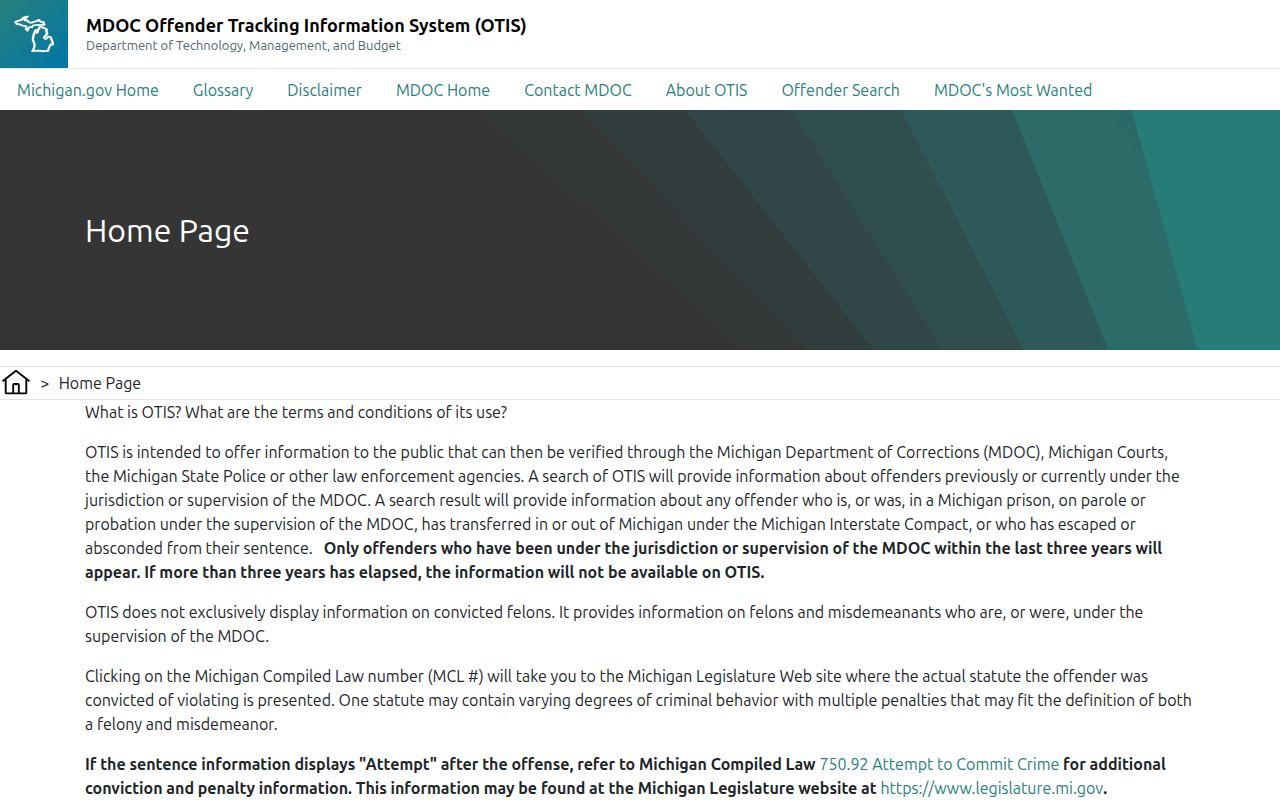
OTIS may display prison, parole, or felony-probation status, sentence fields, supervision dates, and an assigned location or office where public. It is not a complete list of misdemeanors or Calhoun court cases. Check the sentencing court’s register for the order and later violation hearings. District misdemeanor probation may require the 10th District Court channel.
The MDOC parole and probation page explains the state supervision layer.
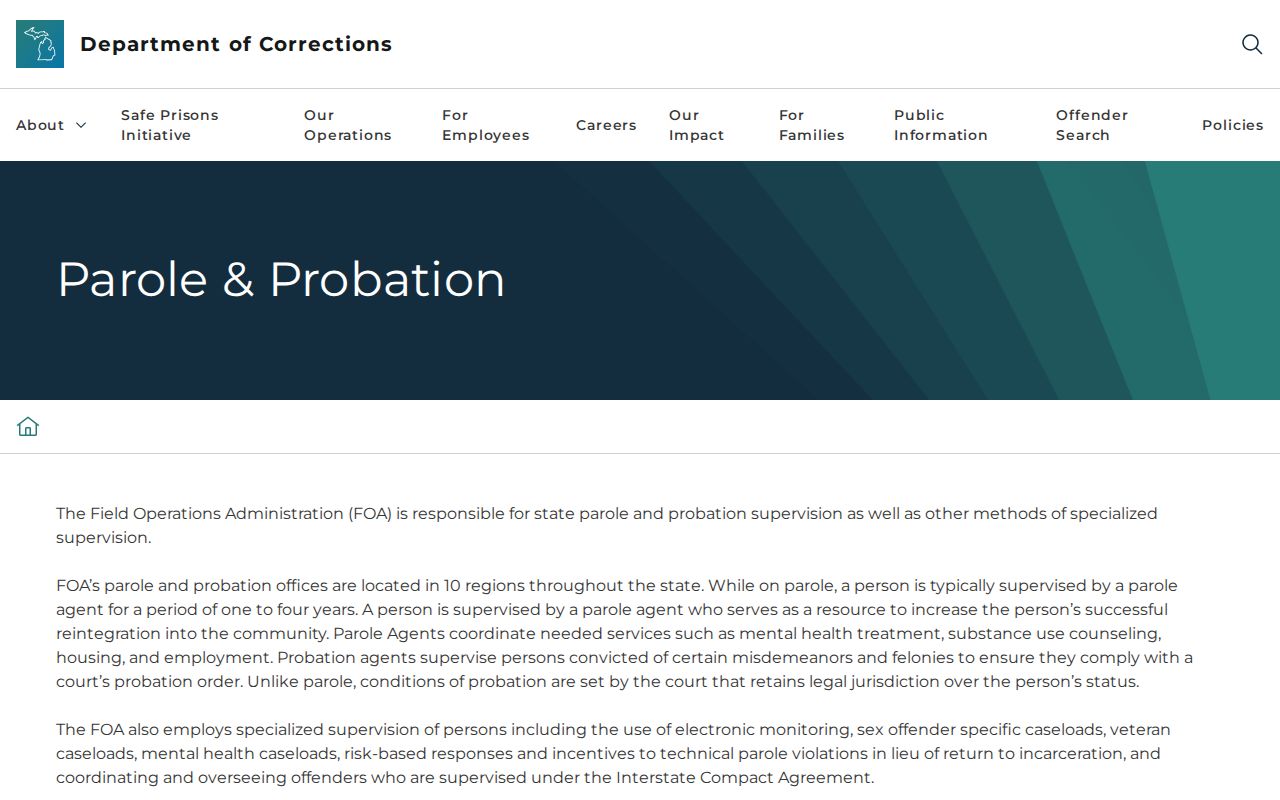
The Michigan Parole Board decides parole release under state law. A supervision status should be read with the sentence and court record, not as a substitute for either.
Calhoun Court Workload Context
The State Court Administrative Office’s 2025 judicial-resources report estimated 127 percent average workload across the 37th Circuit, Calhoun Probate, and 10th District courts. It calculated a need for 11.44 judicial positions against nine judges and recommended one added circuit judgeship. The report also listed a 2024 county population of 133,785 and a district caseload of 28,878, excluding parking matters.
These figures give context, not a promised response time. Precise case numbers and narrow copy requests still help clerks locate the right file. Calhoun also operates a 37th Circuit hybrid DWI and drug problem-solving court. Its review hearings and program milestones can appear on a register of actions and may look different from a standard probation docket.
Federal matters form another layer. PACER is the official electronic docket route for federal court records.
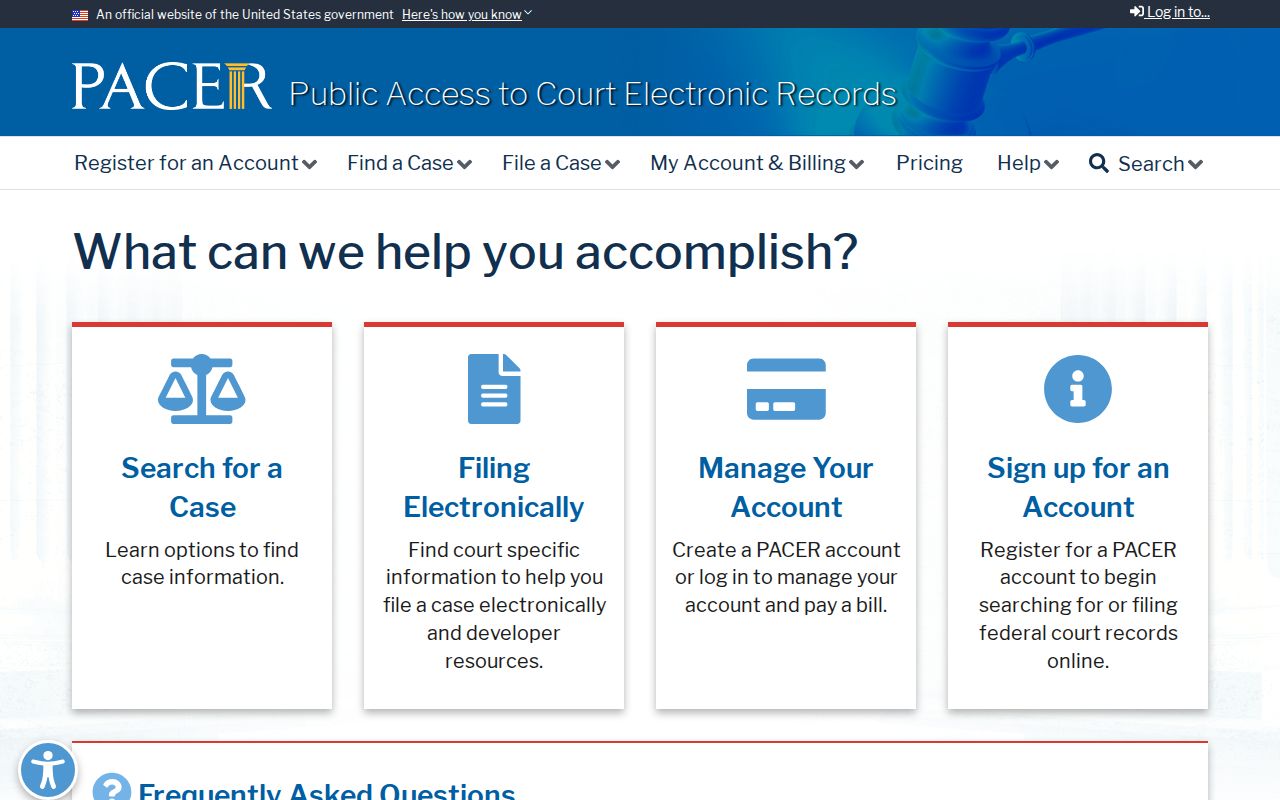
The federal court image points to dockets, not custody. For an identity record, the FBI EDO route accepts a person’s own Identity History Summary request with fingerprints.
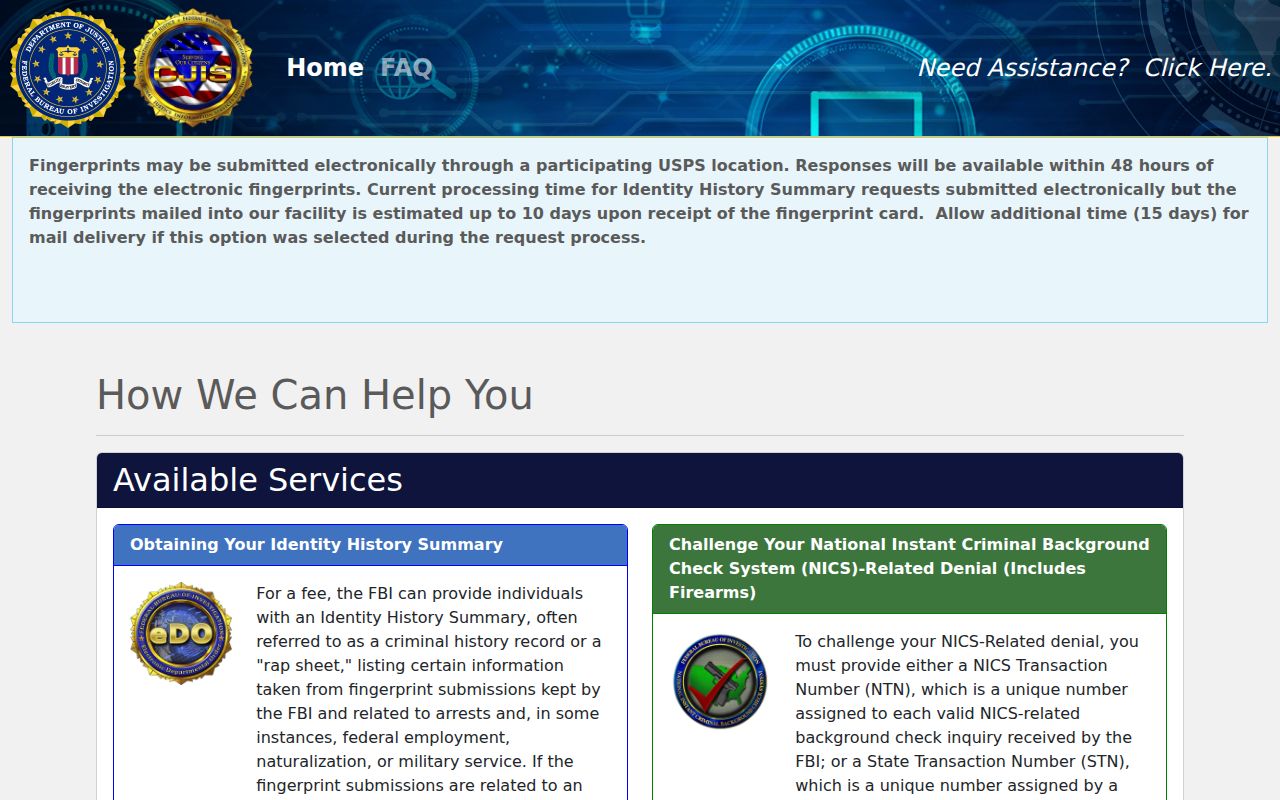
The FBI product is subject-only and does not replace a Calhoun court file. For federal custody, use the Federal Bureau of Prisons inmate locator.
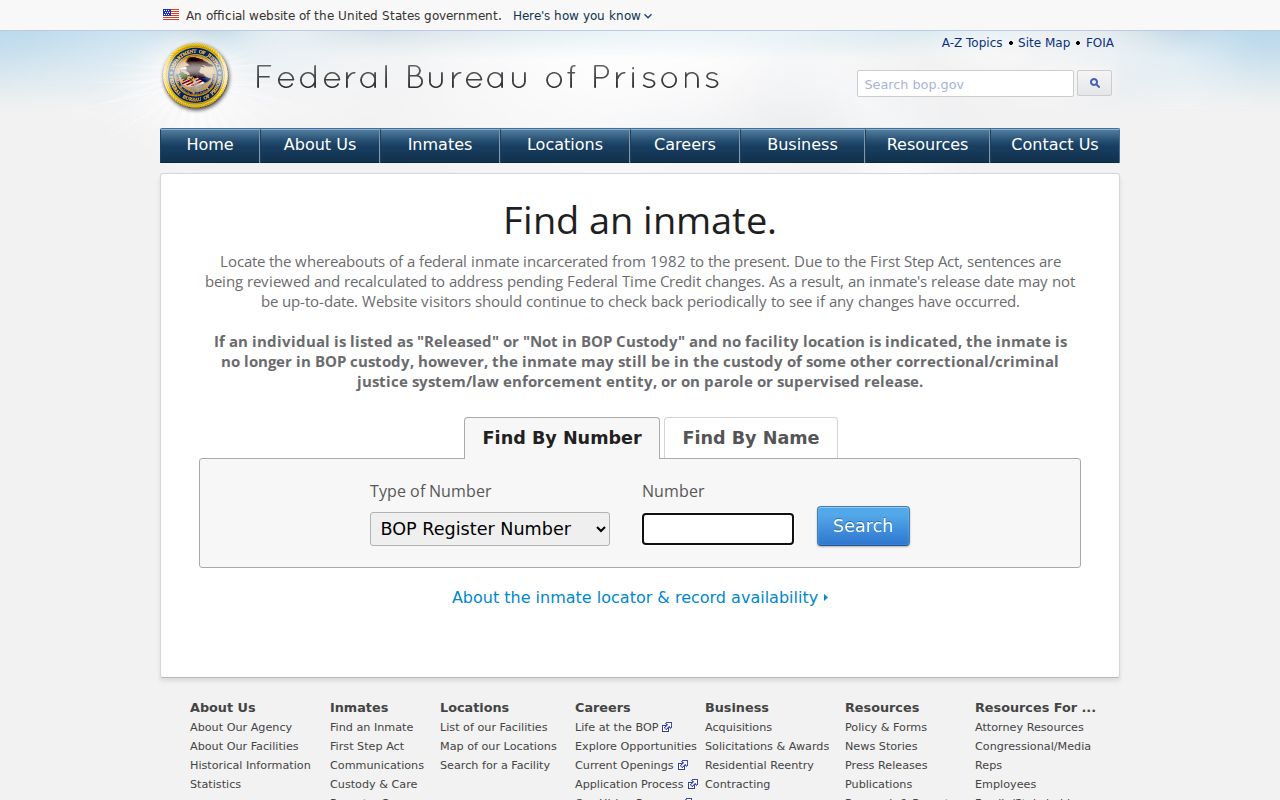
The BOP search covers federal custody, not the Calhoun County jail or Michigan Department of Corrections.
Calhoun County Criminal Records by City
City police departments keep the reports they create, even when a person later enters the county jail or court system. Battle Creek uses its own records division and NextRequest portal. Albion combines police and fire duties in a Department of Public Safety. Marshall has its own police department and city FOIA form. State criminal cases from all three cities route into Calhoun’s 10th District and 37th Circuit structure.
Battle Creek Criminal Records
Population estimate 52,021. City police reports use the Battle Creek records channel.
Albion Criminal Records
Population estimate 7,474. Written report requests go to Albion Public Safety.
Marshall Criminal Records
Population estimate 6,800. Police files and county clerk files remain separate.