
Calhoun County Criminal Court Cases
Calhoun County criminal court cases start in the 10th District Court. That court conducts criminal arraignments, tries and sentences misdemeanors, and handles a felony's probable-cause conference and preliminary examination. When probable cause is found or the examination is waived, the felony is bound over to the 37th Circuit Court. The circuit court then holds the felony case through plea or trial, sentencing, and later activity.
This split explains why one name can produce Calhoun County criminal case records at two levels. The district proceeding is not a duplicate of the later circuit file. Each register records the events within that court's role. Use the court named on the notice, then compare case numbers and dates before deciding that two entries concern the same prosecution.
Start With Calhoun District Court
The 10th District Court is the practical first stop when the charge level is not yet clear. It has final authority over misdemeanors punishable by no more than one year. It also creates the early Calhoun County felony record before bindover. Those early entries can include the complaint, arraignment, bond, probable-cause conference, preliminary examination, and bindover decision.
A searcher should not assume that a felony arrest creates an immediate circuit record. The prosecutor first decides which charge to authorize, and the district phase follows. If the matter is dismissed there, no later circuit case may exist. If it advances, the circuit clerk opens the next file. This timeline makes the district register vital when the circuit result alone lacks the start of the case.
Searching Calhoun County Case Records
The official Michigan Courts Case Search, or MiCOURT, is the public online starting point. Its controls change with the selected court, so choose the Calhoun location before entering a name or case number. A case number is the strongest key. A name search can find possible matches, but common names and incomplete identifiers require a careful review.
- Open MiCOURT and select the participating Calhoun court or location.
- Choose the case-number route when the number is known; otherwise use the party-name route.
- Add the first name and any available date, year, or case-type filter to narrow results.
- Open the matching register of actions and compare filing date, court, charge, status, and disposition.
- Ask the correct clerk for a copy or certified disposition when the online register is not enough.
| Field or Control | Type | Required | Use |
|---|---|---|---|
| Court or location | Selector | Yes | Choose the participating Calhoun court first |
| Search by Case | Tab | No | Opens the case-number route |
| Case Number | Text | For case route | Use the court's case-number format |
| Last Name/Business Name | Text | For name route | Searches a public party name |
| First Name | Text | Optional | Narrows common surnames |
| Case category/type | Filter | Optional | Options depend on the selected court |
Calhoun County's court warrant information page shows how a court-specific issue may need a separate official channel.
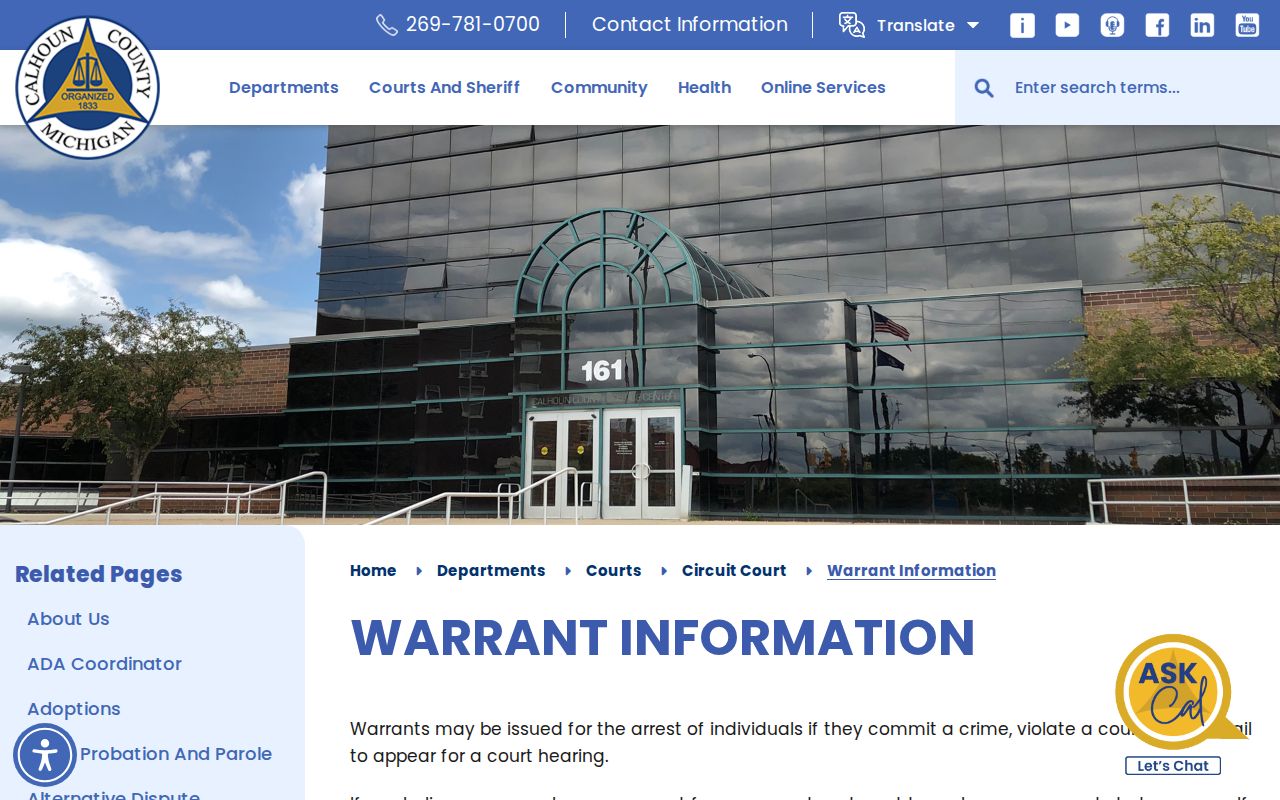
The warrant page is context for court-issued process, not a substitute for reading the criminal case register and confirming status with the court.
Read Calhoun Registers of Actions
A register of actions is the court's dated list of filings, hearings, orders, and outcomes. It helps reconstruct the Calhoun County criminal court case without turning every line into a separate judgment. A complaint is the initial sworn charging claim. An information is the prosecutor-filed charging document commonly used after a felony bindover. A disposition is the result of a charge, such as conviction, acquittal, or dismissal.
Read entries in order. Compare the charge at filing with the charge at disposition because a plea, amendment, or dismissal can change the final result. A scheduled hearing does not prove it occurred as first listed. Likewise, the presence of a warrant entry does not reveal whether it remains active. The status and later entries supply the needed context.
Calhoun County's hybrid DWI/drug court can add review hearings and program milestones that differ from a standard probation docket. Those entries reflect a named problem-solving program, not a new charge by themselves.
Inside a Calhoun County Case File
The Calhoun County court file focuses on filed charges and judicial action. It does not replace a Battle Creek police narrative or a jail booking record. The public register may show the core fields below, while access to the underlying complaint, motion, order, or judgment can vary. Protected identifiers, victim or minor data, sealed material, and nonpublic documents will not appear in the ordinary public view.
| Case Number and Court | Identifies the district or circuit file and its court level. |
|---|---|
| Case Header | May show filing date, case type, status, judge, and public party roles. |
| Charge | Lists description, statute, offense level, date, and charge disposition where public. |
| Bond | May show amount, type, and public conditions. |
| Register Entries | Chronological filings, hearings, orders, pleas, trial events, and review dates. |
| Disposition and Sentence | Shows the outcome and may list custody, probation, fines, costs, or restitution. |
Calhoun County criminal case copies and certification prices were not found on a stable official fee page. Contact the clerk before ordering and state whether an ordinary copy or a certified disposition is needed.
Calhoun Prosecutor or Court Clerk
The Calhoun County Prosecuting Attorney decides which charges to authorize and prosecutes the case. That role does not make the prosecutor the normal source for the official court register or certified judgment.

The image identifies the charging office, while the clerk remains the custodian for the court-file copy. Police reports still come from the agency that created them.
This custodian split prevents many stalled requests. Ask the prosecutor about prosecution functions, the clerk about filed court documents, and the police agency about its report. The county Public Defender has another role: representation after court appointment and an eligibility process. Contacting that office does not itself create an appointment or turn it into a record-copy desk.
How a Criminal Case Moves
A Calhoun County criminal court case moves according to the charge and rulings, not a fixed promise of time. A misdemeanor can remain in district court. A felony moves through its district preliminary phase before a circuit file carries the trial-level proceedings. The prosecutor may amend or dismiss a charge, while the judge controls court rulings and sentence.
Case flow: Charges Filed › Arraignment › Pretrial › Plea or Trial › Disposition › Sentencing
Calhoun's courts operate under an approved concurrent-jurisdiction plan linked to Michigan Supreme Court Administrative Order 2012-6. The plan connects the 37th Circuit, 10th District, and Probate Court for administration. It does not merge every criminal record into one file or erase the need to select the right court in MiCOURT.
Older Calhoun Criminal Case Files
When MiCOURT has no document to download, write down the court, full case number, party name, approximate year, and exact item sought. Then contact the clerk. Older, archived, or non-online material may require a different retrieval step, and a register entry alone does not guarantee that a PDF is available at no charge.
Ask about the record's location, available request methods, copy cost, certification charge, and any archival retrieval rule. Keep the request narrow. Calhoun trial courts had an estimated 127 percent average judicial workload in the state judiciary's 2025 analysis, so a precise case number and document title can help the clerk identify the right file without a broad search.
Correcting a Calhoun Case Outcome
If a Calhoun County disposition appears wrong or is missing from ICHAT, begin with the underlying court register. Obtain proof from the court that decided the charge. A certified disposition or order gives the Michigan State Police a source document when the state criminal-history cycle needs correction. MSP cannot create a result that the reporting court has not supplied.
The official Calhoun County Public Defender page illustrates the separate role of defense counsel and appointment information.
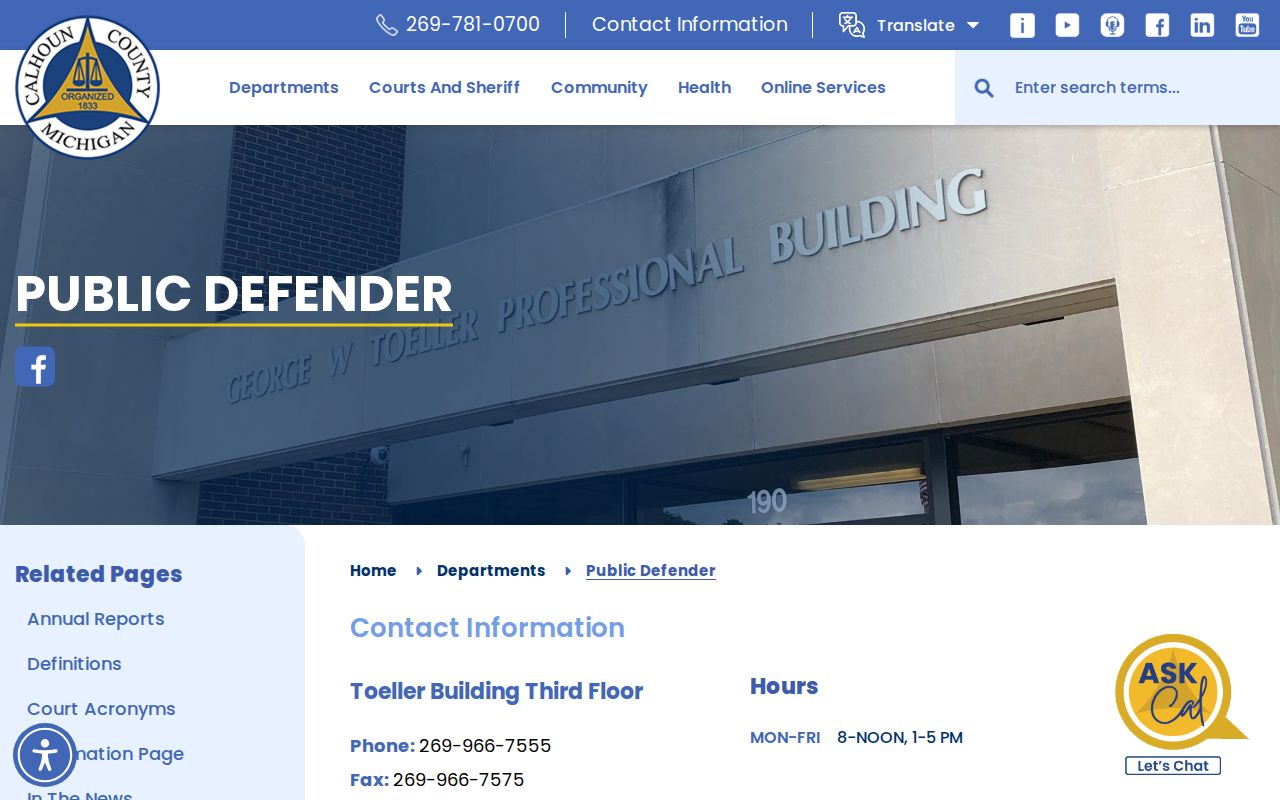
The office may address representation in an appointed matter, but court-record correction still starts with the clerk and the official case outcome.
Case Record Access and Restrictions
Michigan Court Rule 8.119 generally makes court records public, subject to court rule, statute, sealing, and other access limits. Michigan FOIA governs executive-branch agency records, but it is not the process for demanding a court file from the clerk. This distinction matters in Calhoun County because the police report, jail booking, prosecutor material, and court register may describe one event while remaining separate records.
Public views exclude sensitive identifiers, protected victim or minor information, sealed material, and other nonpublic documents. Juvenile records are generally confidential. A valid set-aside also limits ordinary public access, though courts and law enforcement can retain authorized access. If no public result appears, do not treat that absence as proof that no case ever existed.
Access rule: Use the court clerk for court records under Michigan Court Rule 8.119. Use Michigan FOIA for records held by a police agency or another executive office.